English
 中文
中文

The TS-PON (Time Slotted Passive Optical Network) multi-service aggregation transmission system is a deterministic all-optical access solution deeply customized for industrial applications, built upon an enhanced GPON time-division multiplexing architecture.
1. Product Overview
The TS-PON (Time Slotted Passive Optical Network) multi-service aggregation transmission system is a deterministic all-optical access solution deeply customized for industrial applications, built upon an enhanced GPON time-division multiplexing architecture. Building upon standard PON passive optical networks, it integrates high-precision time-slot scheduling, full-network clock synchronization, hardware-based bandwidth slicing, and industrial protocol adaptation technologies. This innovation addresses the limitations of traditional Ethernet and conventional PON networks—such as significant latency jitter, service conflicts, and inadequate real-time performance—while offering superior reliability, low latency, interference resistance, ease of deployment, and capability for multi-service convergence. It is fully compatible with demanding transmission scenarios including industrial environments, smart security systems, and IoT data acquisition applications.
The entire system employs a standardized two-tier architecture comprising central aggregation equipment (ROOT) and front-end user terminal devices (NODE), leveraging an Optical Distribution Network (ODN) to achieve a full-optical transmission topology with point-to-multipoint and hybrid tree-chain networking configurations. Compared to traditional networking approaches such as switch cascading, serial bus configurations, or point-to-point optical terminals, TSPON's passive optical distribution architecture significantly reduces the number of active device layers and the complexity of data center deployment, offering simplified cabling, flexible scalability, and lower operational costs. Additionally, it inherently possesses fiber-optic characteristics including electromagnetic interference resistance, lightning protection, and long-distance transmission capabilities, making it well-suited for complex electromagnetic environments such as outdoor settings, industrial sites, rail transit systems, and field monitoring applications.
2. System Composition
2.1 Description of the System Solution
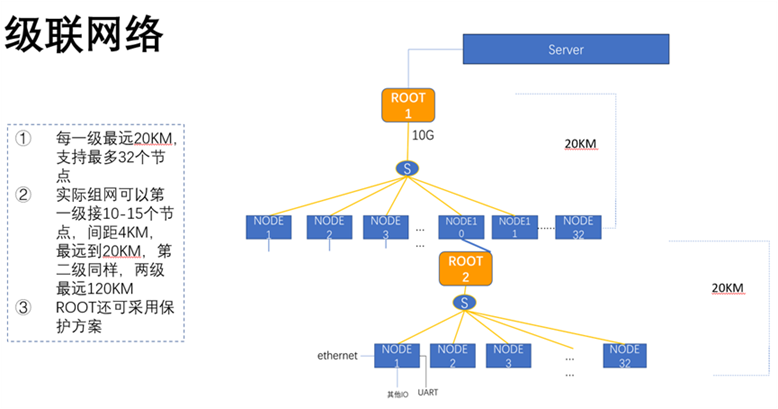
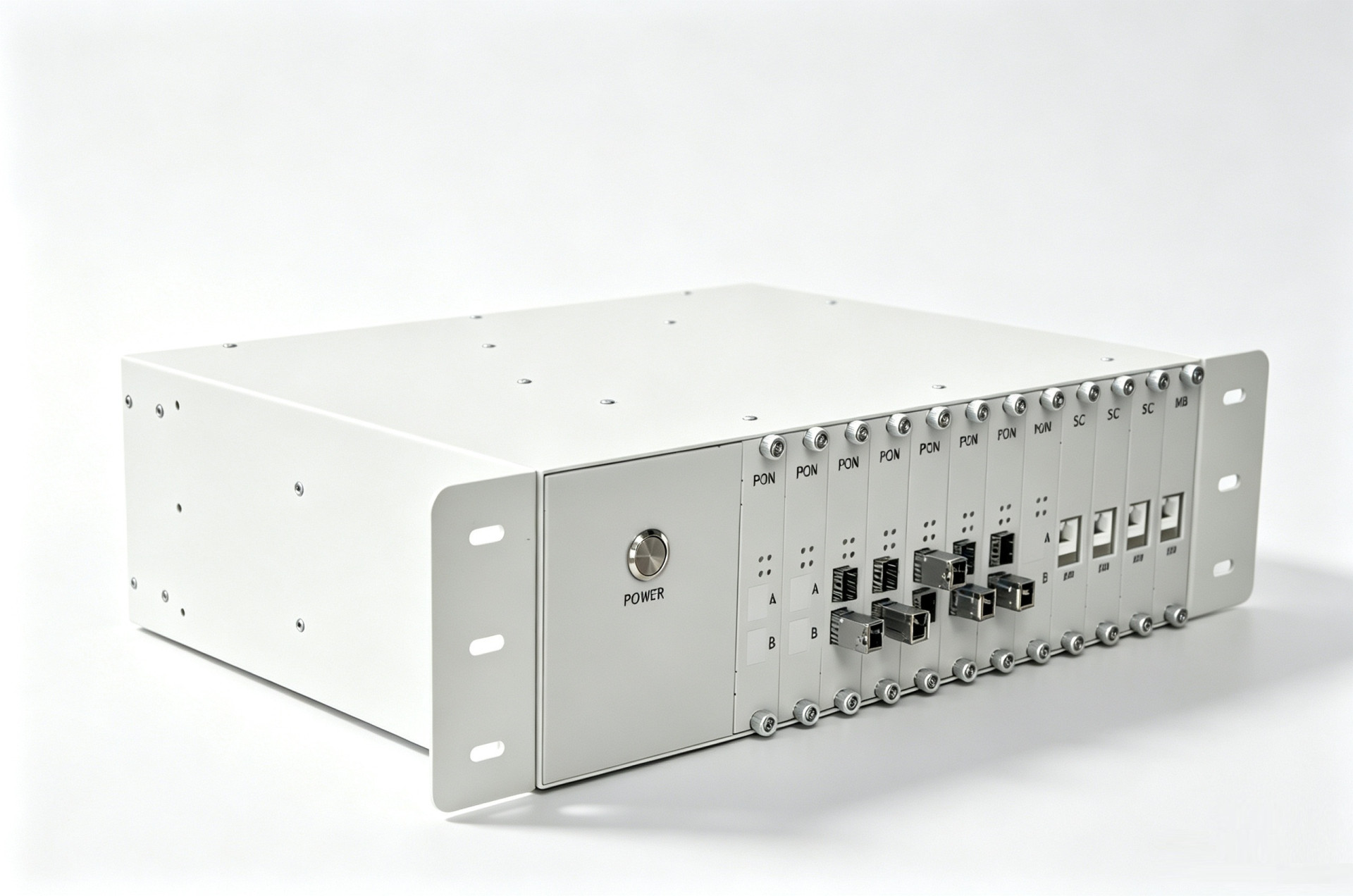
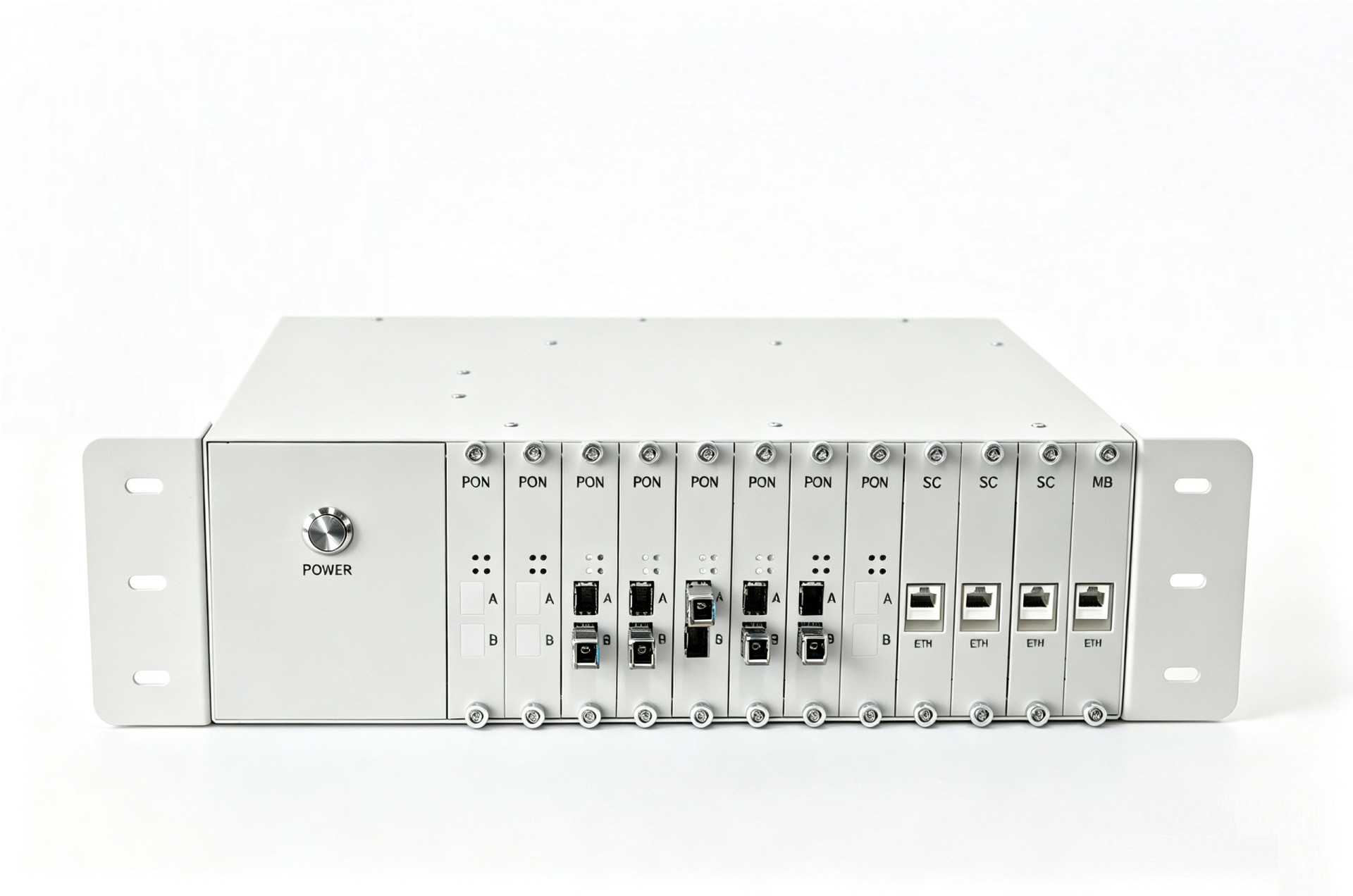
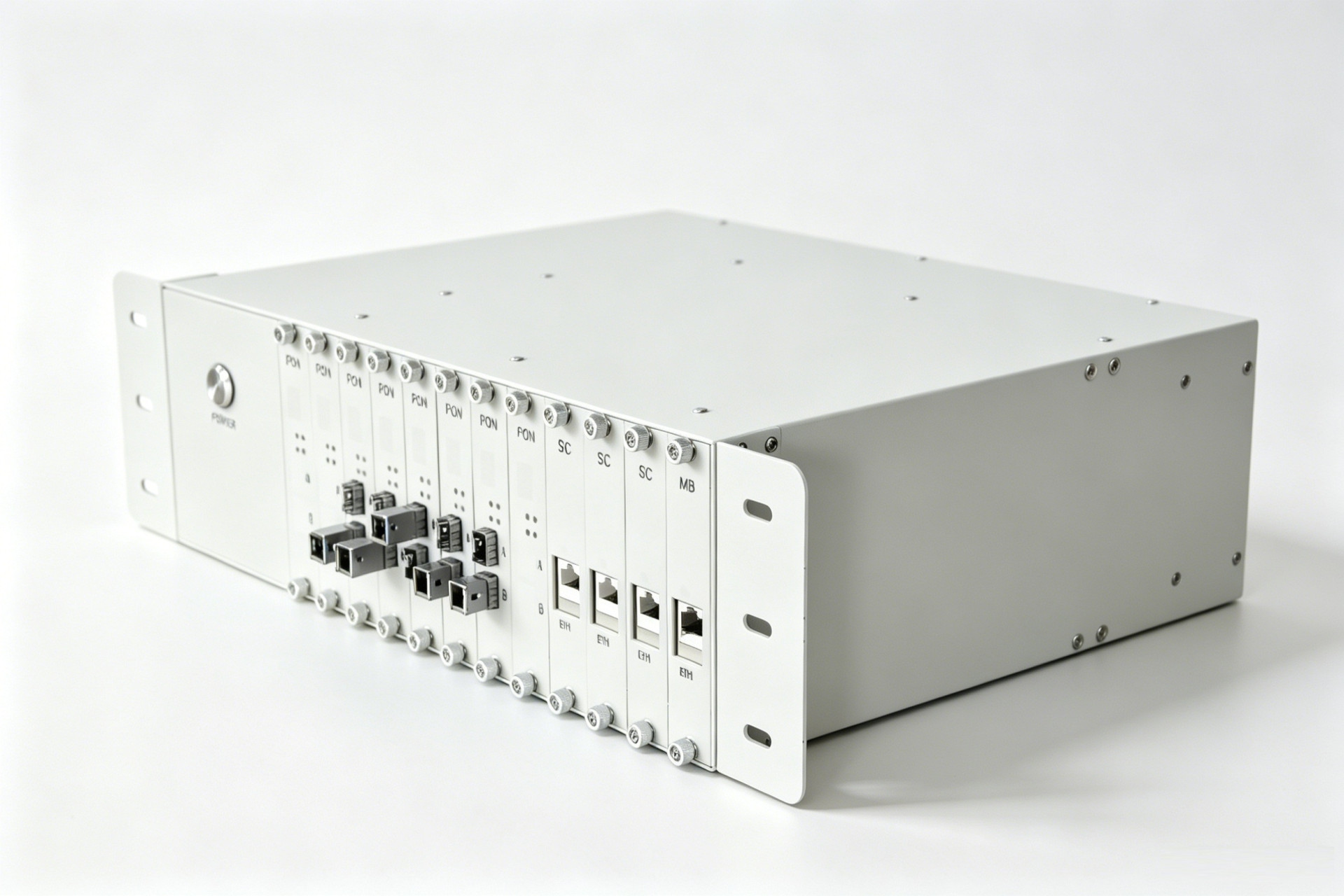
Aggregation devices: Installed in the server room or control center, providing uplink interfaces and PON downlink interfaces. Each device can connect up to 8 PON (ROOT) boards, with each board supporting 16 NODE devices. The system supports a total of 128 station-segment NODE devices.
Terminal Device (TS-PON NODE): Up to 16 units per ROOT, deployed on-site with a coverage range of 20 km. Each node supports three Ethernet service connections.
It can be used and connected in series as a relay device within the system, with a maximum series length of 120 km.
Passive splitter: 1:2 or 1:6 cascaded or series configuration, with a maximum of 16 nodes in series. Actual engineering requirements should be determined based on site conditions before designing the wiring configuration.
2.2 System Features
Characteristic | Specification Parameters |
Time delay | Millisecond-level |
Tape width | <1000mbps |
Transmission distance | 20km |
Terminal mobility | Nonsupport |
Safety | Gao |
Business isolation | Physical isolation (tdm) |
Maximum series | 16 units |
Cooling-down method | Air-cooled (underflow suction) |
3. Equipment Technical Specifications
3.1 Aggregation End Device (ROOT Cluster)
Project | Specification parameters |
Unit type | Ts-pon-root-ac |
Upper interface | 3 × 10/100/1000 base-t adaptive ethernet ports (rj45) 1×1000base-x sfp optical port (optional) |
Pon interface | 1 × pon port, sc/pc single-mode fiber connector Complies with the ts-pon physical layer specification |
Pon speed | Downlink: 1.25 gbps, uplink: 1.25 gbps (symmetric) |
Transmission distance | Maximum 20 km (requires corresponding optical module) |
Maximum root board count | 8 block |
Business edition sc | 3 block |
Management board mc | 1 block |
Support number of nodes | 16*8=128 |
Operating wavelength | Down: 1490 nm; up: 1310 nm |
Optical power budget | > -23dbm |
Qos | Supports priority-based scheduling based on business type |
Network management method | Cli(console/telnet/ssh),web gui,snmp v2c/v3 |
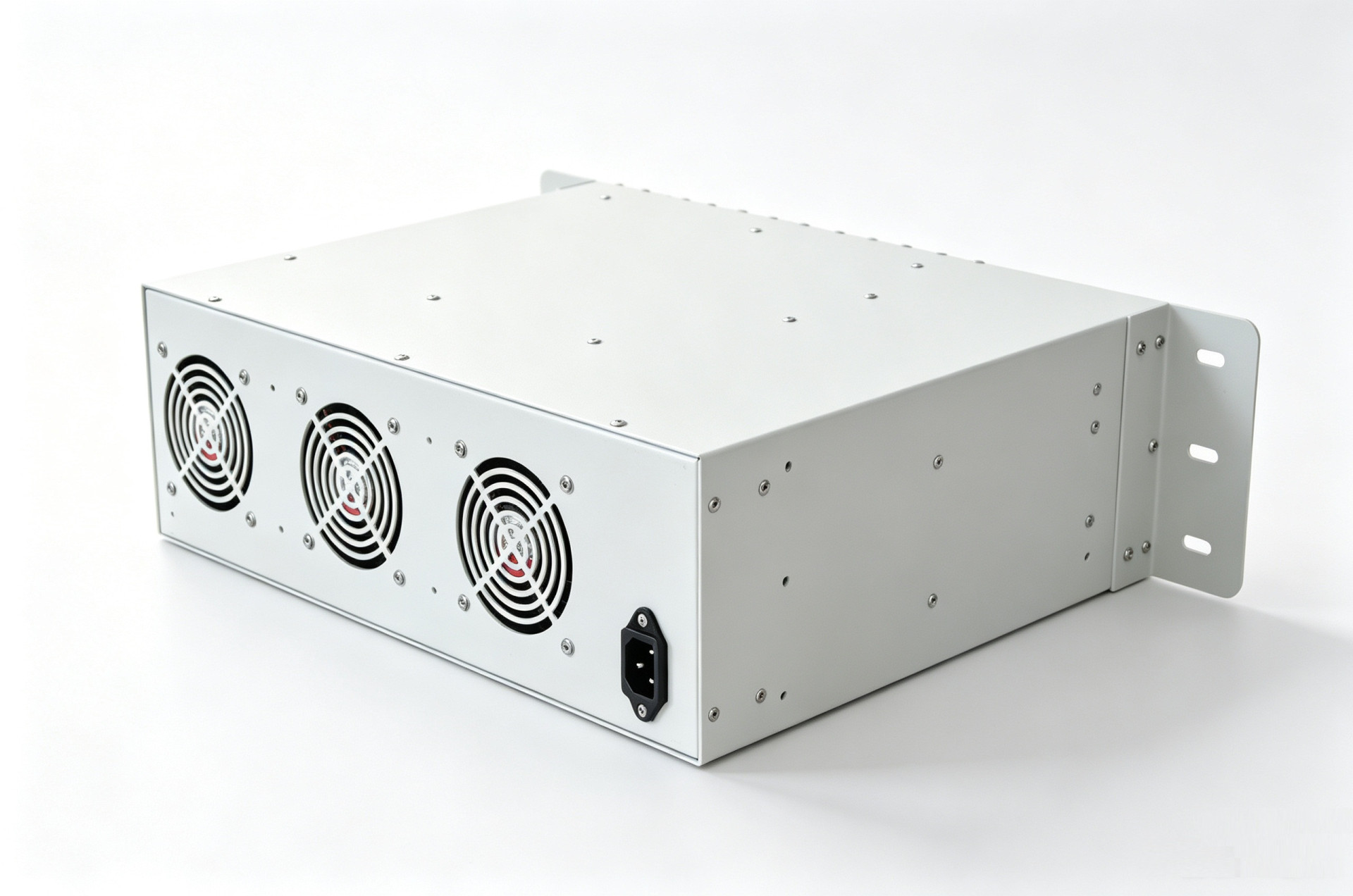
Source | Ac 100–240 v, 50/60 hz; redundant power supply available |
Power dissipation | ≤30w |
Work environment | Temperature: -10°c to 55°c; humidity: 5% to 95% (non-condensing) |
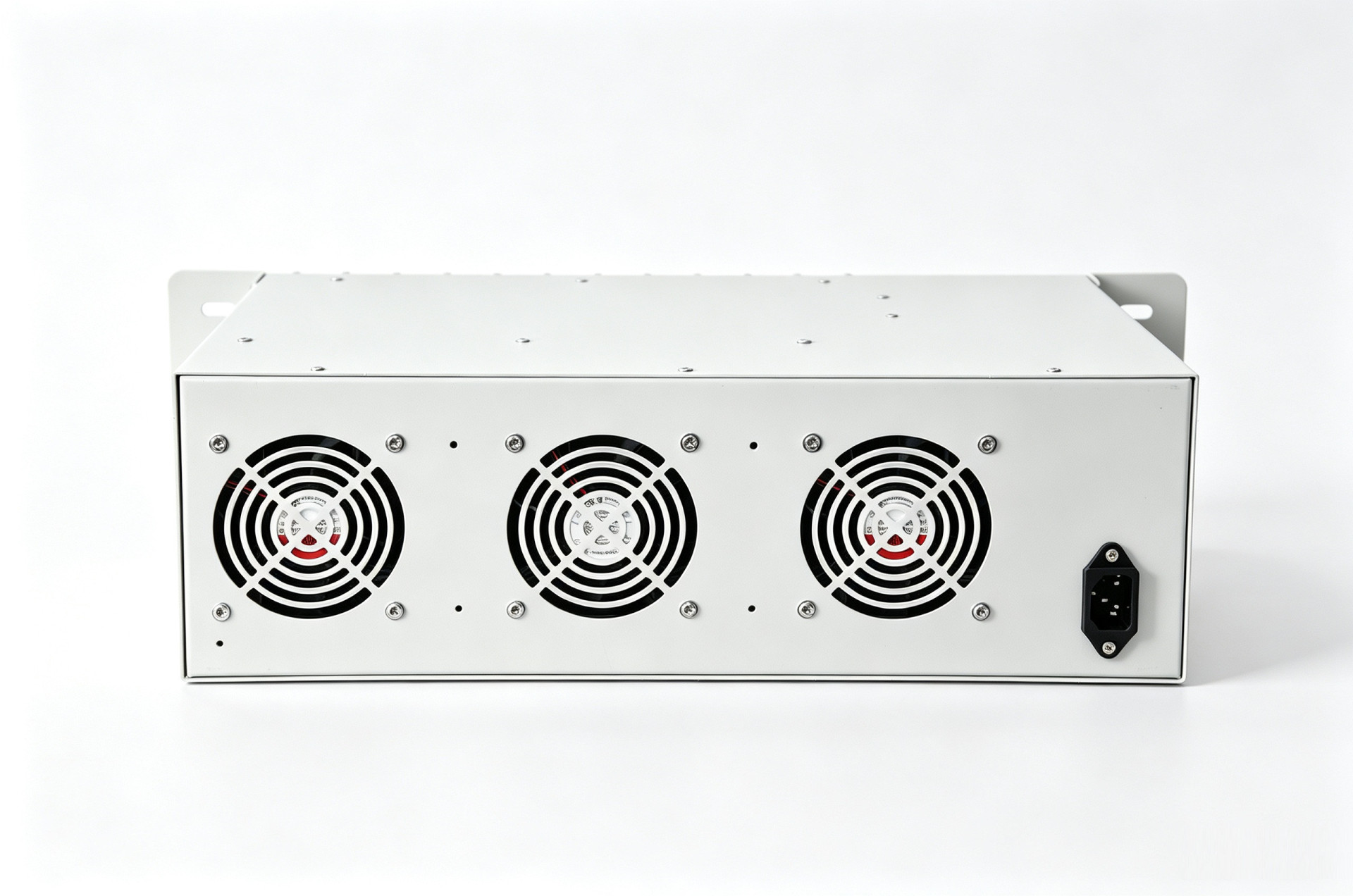
Size | 3u standard rack mount (height: 133 mm; width: 414 mm; depth: 320 mm) |
Weight | ≤3.5kg |
3.2 Terminal Device (NODE)
Project | Specification parameters |
Unit type | Ts-pon-node-2fe1t |
Pon interface | 1 × pon port, sc/pc single-mode fiber connector Complies with the ts-pon physical layer specification |
Customer interface | Ethernet ports: 2 × 10/100base-t adaptive ethernet ports (rj45) for connecting cameras or ipcs |
Pilot lamp | Pon link status, ethernet link/action, ttl transmission/reception, power supply |
Transmission distance | Similar to root, up to 20 km |
Operating wavelength | Corresponds to root: uplink at 1310 nm, downlink at 1490 nm |
Optical power budget | > -23dbm |
Data transparency | Supports transparent ethernet data transmission |
Configuration management | Supports remote centralized configuration, upgrading, and monitoring via root |
Source | Dc 12v/1a (adapter power supply) or poe power supply (optional, customizable) |
Power dissipation | ≤5w |
Work environment | Temperature: -20°c to 70°c; humidity: 5% to 95% (non-condensing) |
Size | 130 mm × 80 mm × 28 mm (for wall mounting or rail installation) |
Weight | ≤0.5kg |
4. Technical Specifications
4.1 Technical Features of TS-PON Technology
TS-PON (Time-Sensitive PON, Time-Sensitive Passive Optical Network) is an innovative communication technology that combines the strengths of Time-Sensitive Networking (TSN) and Passive Optical Network (PON). Its core mechanism employs a high-precision time synchronization system to assign fixed uplink time slots to each node, enabling time-division synchronous multiple access that fundamentally prevents data conflicts while ensuring reliable transmission with low latency. Key features of this technology include:
Ø Ultra-low latency guarantee: Supports configuring fixed bandwidth channels for camera video streams, with an end-to-end latency ≤ 2 ms.
Ø Long-range coverage: Supports up to 20 km of fiber-optic transmission, ideal for distributed monitoring scenarios such as campuses, roads, and industrial sites, enabling wide-area deployment without repeaters.
Ø Flexible bandwidth allocation: Offers three modes—fixed bandwidth (CIR), guaranteed bandwidth (CIR+PIR), and best-effort bandwidth—which efficiently handle mixed traffic from video streams and various signal streams while ensuring bandwidth availability for critical services.
Ø High bandwidth and seamless evolution: Currently supports up to 10 Gbps transmission rates, with future smooth upgrades to even higher bandwidths to meet growing business demands.
Ø Enhanced anti-interference capability: The optical fiber medium inherently resists electromagnetic interference, ensuring stable and reliable signal transmission.
Ø Excellent scalability: Featuring a point-to-multipoint architecture that supports flexible addition or removal of nodes, making network expansion and maintenance straightforward.
TS-PON achieves high-precision time synchronization through time-slicing technology, delivering a bandwidth-efficient, low-latency, and highly reliable access solution for latency-sensitive applications such as industrial control and smart monitoring systems.
4.2 Multi-service Access Capability
The system utilizes a QoS mechanism to prioritize the scheduling of various types of traffic, providing differentiated quality assurance for different services. The supported service categories are as follows:
In video services, node devices connect to standardized network cameras via Ethernet interfaces, enabling transparent video stream transmission and uplink aggregation to the central device's upstream port. The system also supports VLAN-based service isolation and priority identification, ensuring stable video transmission performance.
The serial data service features integrated serial port protocol conversion at the node end, capable of encapsulating traditional serial data into IP packets and routing them uniformly to central equipment via the PON transmission network. The central end forwards the data to the backend data center using TCP or UDP protocols. The system supports concurrent transmission of multiple serial channels, with each channel allowing independent configuration of communication parameters such as baud rate and data bits; external adapter devices are required for practical implementation.
For industrial control applications, particularly those requiring real-time data transmission in sectors like power generation, the TS-PON system enables dedicated allocation of high-priority transmission channels, significantly reducing data forwarding latency and meeting the industry's demands for low-latency, highly reliable command transmission.
4.3 Reliability and Maintenance
The optical link diagnosis function leverages the central ROOT management node to establish a comprehensive monitoring system, enabling round-the-clock real-time online monitoring of the operational status of all remote nodes across the network. It accurately collects key optical path parameters including real-time uplink/downlink transmission power values, actual fiber link transmission distances, and real-time bit error rates at each node. The system automatically performs intelligent analysis and comparison of collected data; upon detecting various fiber optic faults such as abnormal optical power fluctuations, excessive link loss, sudden bit error increases, or optical path interruptions, it immediately identifies the fault location and type without requiring operators to conduct segment-by-segment on-site investigations. This significantly reduces troubleshooting time, enables rapid fault localization and emergency response, thereby enhancing overall operational efficiency and fault resolution responsiveness of the optical transmission network.
The NODE node remote management function provides the entire network system with comprehensive centralized operation and maintenance control capabilities for remote nodes. Administrators can exercise unified remote management over all NODE-connected nodes across the network via a central management platform, significantly reducing on-site maintenance staffing requirements, streamlining daily operation procedures, lowering field operational costs, and achieving standardized, unified management of all network devices—thereby substantially enhancing overall network operation convenience and management efficiency.
The system features a 1+1 link hot backup capability, with each device equipped with dedicated independent A and B service transmission ports that natively support the 1+1 primary/secondary link redundancy mechanism. These ports can be connected to two mutually independent physical transmission links serving as the primary and backup paths respectively. The system enables millisecond-level automatic link switching, seamlessly transitioning to the backup port to continue transmitting business data without any service interruption or packet loss, thereby ensuring uninterrupted operation of critical services such as voice communications, Ethernet data, and IoT applications while completely eliminating the risk of network-wide service downtime caused by single-link failures.
The intelligent ring network protection function ensures full compatibility of the central ROOT core device with professional ring network protection mechanisms, supporting dual PON port redundant networking modes and uplink aggregation deployment configurations. It enables rapid self-healing and reconstruction of ring network links, guaranteeing stable communication between all nodes within the ring. This protection function is deployed through dedicated system software authorization, offering flexible deployment and strong adaptability. It comprehensively enhances the overall operational stability, resilience, and emergency communication reliability of the entire optical communication system at the network architecture level, fully meeting requirements for high-reliability applications such as emergency communications and private network transmission.
5. Physics and Environment
5.1 Aggregation Device (ROOT Cluster)
Installation Method: 19-inch standard rack installation
Air distribution method: bottom intake, rear exhaust duct; equipped with an internal temperature-controlled fan.
Protection rating: IP20
Installation requirements: There must be at least 1U of clearance below the device.
5.2 Terminal Device (NODE)
Installation method: Wall-mounted, DIN rail, or desktop placement
Shell: Made of metal, with an IP30 protection rating
Connectors: PON interface (SC/PC), Ethernet port (RJ45), and serial interface with plug-and-play terminals.
6. Typical Application Topologies
6.1 Typical Application Topologies
6.2 MESH Network Expansion
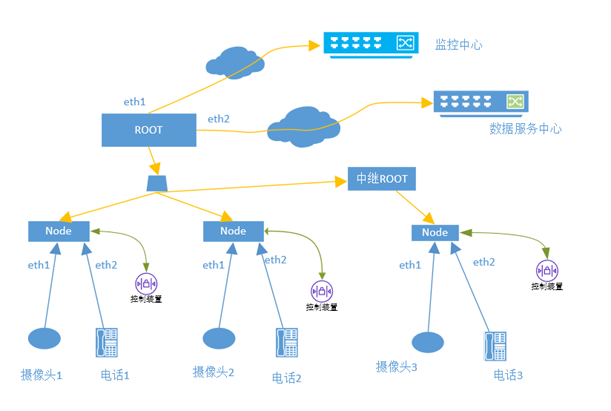
This system can expand its coverage by connecting to any node via a MESH network.
7. Technical Advantages
Ultra-low latency transmission: The system employs a self-developed TS-PON transmission architecture, achieving microsecond-level ultra-low data forwarding latency. This fully meets stringent real-time requirements in applications such as power industrial control and remote control, ensuring efficient and reliable command interaction.
The device features a compact design and offers convenient, flexible deployment: its front-end node unit is space-efficient and small in size, allowing direct installation on confined spaces such as communication towers or outdoor poles without requiring extensive installation space. It is suitable for various field deployment scenarios including outdoor environments and base stations, with low requirements for both installation and maintenance.
Low-power energy efficiency and environmental friendliness: The device's hardware architecture is streamlined and optimized, resulting in low operating power consumption and reduced long-term energy costs for all-weather outdoor use. It is ideal for lightweight power deployment scenarios such as areas without centralized power supply or those utilizing solar energy.
High environmental adaptability: The equipment exhibits excellent resistance to temperature and humidity fluctuations, dust and moisture, as well as interference, enabling stable performance in various harsh outdoor conditions such as extreme temperatures, thunderstorms, and sandstorms. It operates continuously around the clock, significantly enhancing both operational stability and service life of field devices.
8. Order Information
Model | Description |
TS-PON-ROOT-AC | TS-PON aggregation device, featuring 1 pon port and 2 gigabit ethernet ports for upstream connectivity, powered by ac electricity |
TS-PON-ROOT-AC-R | Aggregated devices, redundant power supply version |
TS-PON-NODE-FE1T | Ts-pon terminal device: 2 100 mbps ethernet ports + 1 ttl serial port, dc power supply |
TS-PON-NODE-FE1T-POE | Terminal device supports poe power reception (requires a poe switch). |
TS-PON-SPL-16 | 1:16 planar waveguide optical splitter, sc/pc interface |
TS-PON-SPL-8 | 1:8 optical splitter for cascading |
Note: The product is continuously evolving. Specifications may change without prior notice. For details, please contact your local sales representative. | |