English
 中文
中文

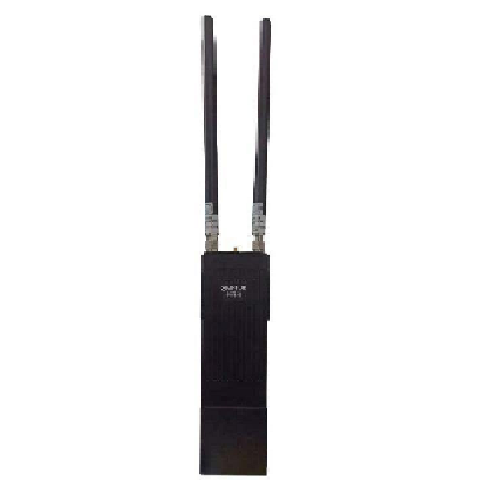
QL-MESH101-2W(1400)
This MIMO dual-channel single-soldier handheld self-organizing network radio offers customizable transmission frequencies ranging from 300 MHz to 1.5 GHz. It employs the latest generation of multi-hop self-organizing network protocols and radio technology, capable of countering complex channel environments.
Product Overview
This MIMO dual-channel single-soldier handheld self-organizing network radio offers customizable transmission frequencies ranging from 300 MHz to 1.5 GHz. It employs the latest generation of multi-hop self-organizing network protocols and radio technology, capable of countering complex channel environments. It facilitates centralized same-frequency self-organizing network broadband service transmission among mobile and fixed nodes such as individual soldiers, vehicles, and drones in complex scenarios.
The radio is equipped with a built-in lithium battery, compact in size, and designed for portability, either handheld or worn. It provides a maximum transmission power of 2W and does not rely on any basic communication infrastructure. It can temporarily, dynamically, and quickly establish a wireless IP network with self-organizing, self-healing, and high-resilience capabilities, supporting multi-hop transmissions of data, voice, and video, among other multimedia services. It meets the needs of users to rapidly establish dedicated networks in emergency scenarios, providing stable transmission channels for voice, messaging, and video IP data services.
When combined with vehicle-mounted self-organizing network radios, this MIMO dual-channel single-soldier portable self-organizing network radio can perform hybrid clustering and tiered networking. Vehicle-mounted radios form the backbone of long-distance communication networks, while the single-soldier portable self-organizing network radios create squad subnets, supporting multi-hop communication of video, voice, and data. Various IP devices such as smartphones, tablets, and PCs can connect to the network through the radio’s Ethernet port or Wi-Fi AP, facilitating interconnectivity among various IP terminals. Additionally, the radio can provide direct 12V DC power to peripherals such as cameras from its own battery.
Significant Advantages
Ø Long Transmission Distance: Utilizing OFDM+MIMO, space-time coding, and transmit/receive diversity technologies, this system achieves a receiver sensitivity of -96dBm. With a 2W transmission power, it can achieve over 20 km of air-to-air/air-to-ground line-of-sight communication, and 5-10 km of ground-to-ground line-of-sight communication. It also performs well in non-line-of-sight conditions, offering strong anti-multipath interference and diffraction capabilities.
Ø High Transmission Rate: Using OFDM and adaptive modulation techniques such as BPSK/QPSK/16QAM/64QAM, along with receive diversity, the system can reach peak rates of over 80+ Mbps, making it suitable for high-volume multi-hop transmissions.
Ø Large Network Scale: The system employs the CSMA/CA protocol with dynamic channel resource allocation, supporting networking of up to 32 nodes.
Ø Multiple Relay Hops: Practical tests have shown that video relay can reach up to 8 hops, expanding the network coverage and enhancing the applicability of network applications.
Features
1. Software Architecture: A decentralized, distributed wireless self-organizing network based on the IP system.
2. Multipath Interference Resistance: OFDM multicarrier modulation provides strong resistance to multipath interference.
3. Diffraction Capability: Exhibits strong diffraction and penetration abilities.
4. MAC Protocol: CSMA/CA.
5. Dynamic Routing: Layer two intelligent routing protocols, smart dynamic routing, and path optimization.
6. Flexibility: Highly scalable, with nodes able to dynamically join and leave the network.
7. Mobility: Tested node maximum mobility speed is 300 km/h.
8. Damage Resistance and Self-Healing: Individual terminal damage does not impact network operations, offering strong resilience.
9. Operating Modes: Supports star, mesh, chain, point-to-point, point-to-multipoint, and multipoint-to-multipoint configurations.
10. IP Transparency: Supports transparent IP transmission between Ethernet ports, and between Ethernet and serial ports.
11. Internet Extension: Effectively extends the internet coverage; any terminal within the network can serve as a gateway, allowing all nodes to access the internet via gateway nodes.
12. Static Routing: Supports manual setting of static routes for designated transmission paths in special cases.
13. Map Display: Supports geographic location display when connected to GPS/Beidou.
14. Spectrum Scanning: Features spectrum scanning capabilities to monitor current spectrum usage and identify interference.
15. Configuration Management: Allows for the setting of radio channel, bandwidth, power, rate, IP, and keys.
16. Status Display: Dynamically displays network topology, link quality, signal strength, and environmental noise levels.
17. WIFI AP: Portable devices such as smartphones, tablets, and computers can dynamically connect wirelessly, serving as application terminals for user interaction (requires user-developed applications).
18. WIFI Client: Can connect to existing WIFI APs to access other networks.
19. Indicator Lights: Power and mesh lights indicate power on, network connection status, signal stability, and network access.
Technical Specifications
Wireless Features
· Network Scale: Single frequency supports up to 32 nodes.
· Communication Frequency: L-band 1400~1500MHz, adjustable in 1MHz steps; other frequencies can be customized.
· Transmit Power: L-band 33dBm (2x1W), adjustable in 1dBm steps; other transmission powers can be customized.
· Bandwidth Modes: 5 / 10 / 20 / 40 MHz; other bandwidth modes can be customized.
· Communication Waveform: TDD-OFDM + MIMO + CSMA/CA.
· Carrier Modulation: BPSK/QPSK/16QAM/64QAM (adaptive).
· Receiver Sensitivity: -96dBm at 5MHz.
· Communication Distance: 20+ km (air-to-air/air-to-ground line of sight), 5-10 km (ground-to-ground line of sight, antenna at least 2 meters high).
Networking Function
· Communication Rate: Peak over 80+Mbps (adaptive or manually set).
· Transmission Delay: Approximately 2ms per hop.
· Multi-Hop Capability: Up to 15 hops for short messages, 10 hops for voice, and 8+ hops for video.
· Mobility Speed: Supports speeds of 300+ km/h.
· Startup Time: 25 seconds.
System Functions
· Network Joining Time: Less than 1 second.
· Routing Switch: Less than 1 second.
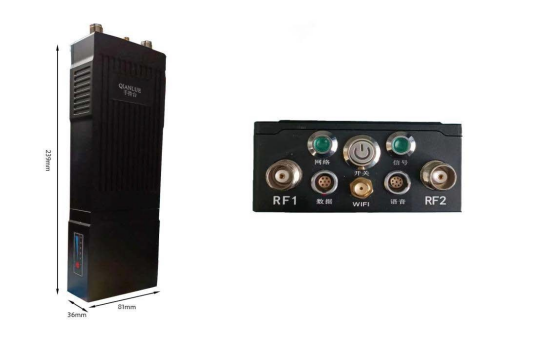
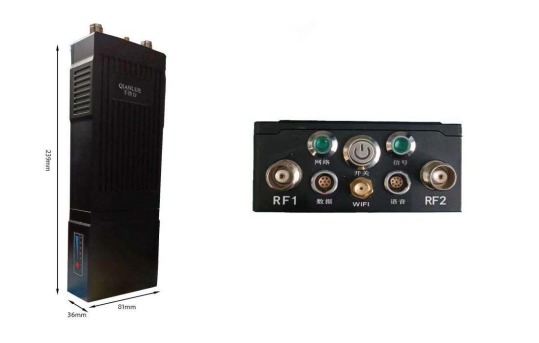
· Data Interface: 1 Ethernet port, 1 RS232, 3.5mm audio interface.
· Network Extension: WIFI AP, integration with public network/satellite.
Physical Characteristics
· Video Input: Supports IP video input; other external expansions possible.
· Satellite Positioning: Internal integration of GPS/Beidou.
· Voice Communication: IP voice conferencing/PTT hand microphone (optional).
· Security Encryption: AES128, AES256.
· Battery Charging: 16.8V/1A.
· Power Consumption: 6~15W, standby 6W, receiving 8W, full-load transmission 15W.
· Operating Time: 4~6 hours (integrated removable 18650 lithium battery).
· Protection Rating: IP65.
· Operating Temperature: -40~+65°C.
· Dimensions: 235 * 78 * 45 mm.
· Overall Weight: Approximately 980g (excluding antenna).
QL-MESH101-2W Handheld Station Dimensions and Interface Drawings
Packing List
packing list | Item Name | quantity |
2-watt single-soldier handheld ad hoc radio | 1 | |
Omnidirectional fiberglass antenna | 2 | |
Quick start guide | 1 | |
Warranty card and certificate of conformity | 1 |
Ordering Information
Equipment selection | Device Information |
Single-Soldier Handheld Radio - L Band
|