English
 中文
中文

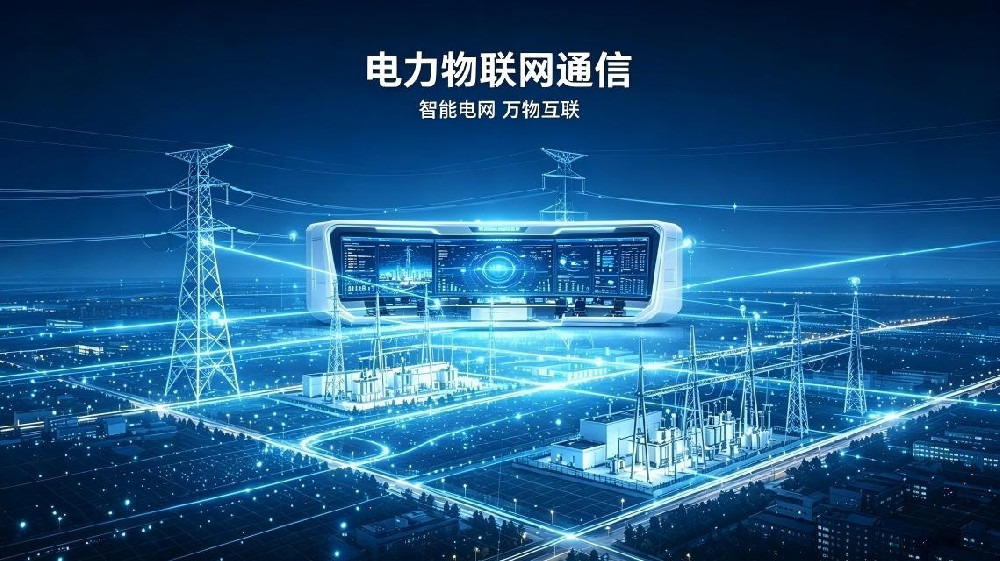
The power Internet of Things communication solution is the core technological framework for enabling intelligent sensing of grid equipment, efficient data transmission, and business collaboration. Its architecture and key technologies are as follows:
1. Tiered design of the overall architecture
It adopts a four-layer standardized architecture (sensing layer, network layer, platform layer, and application layer).
①Perception Layer: Deploy sensors, smart meters, and other terminal devices to collect real-time data on equipment status and environmental conditions, such as temperature, current, and voltage.
②Network layer: It supports mass terminal access through hybrid networking of wired (optical fiber, HPLC broadband carrier) and wireless (4G/5G, micro-power wireless) technologies.
③Platform Layer: Build a unified IoT management platform to enable data aggregation, protocol translation (such as IEC 104/MQTT), and edge computing.
④Application Layer: Supports business scenarios such as intelligent operations and maintenance, coordinated management of generation, grid, load, and storage, and precise fault localization.
2. Core Communication Technologies
①High-concurrency access capability
Distributed IoT platforms, such as EMQX, support millions of device connections and meet the demands of high‑volume, real‑time data transmission.
Hardware resource costs have been reduced by more than 50%, and cluster scaling is employed to handle massive device connectivity.
②Multi-protocol compatibility and conversion
Supports the DL/T 645 electric meter protocol (RS‑485/infrared communication), IEC 104, and other power industry communication protocols.
Heterogeneous protocols (such as IEC 104 and DL/T 698.45) are uniformly converted to the MQTT protocol, enabling efficient data exchange.
③PLC Power Line Carrier Technology
By employing an HPLC broadband carrier module, minute-level meter data acquisition and intelligent distribution‑area management are realized.
Lehe Microelectronics has taken the lead in developing the national PLC standard (GB/T 31983.31), thereby advancing device interoperability.
3.Standardization and Safety
①Comply with the national standard GB/T 40287-2021 to standardize communication interfaces and data exchange protocols.
②The terminal device has passed the GB/T 14598.14 Level III electromagnetic compatibility certification, ensuring reliable operation in complex environments.
This solution leverages a technological approach characterized by “precise sensing, edge intelligence, and open sharing” to provide foundational support for the development of a new‑type power system and to drive the grid’s evolution toward an energy internet.