English
 中文
中文

Remote‑Medical TS‑PON Deterministic Optical Transmission Solution
Meet the future expansion demands of 8K diagnosis & treatment, AI‑powered healthcare and global Internet‑of‑Things deployment.Global Time‑Synchronization: High‑precision clock synchronization across the whole network to achieve unified, traceable and auditable time sequence for medical diagnosis‑related data.
3.2 Core Technical Advantages of TS‑PON
This solution adopts the new‑generation TS‑PON Time‑Sensitive Passive Optical Network, which integrates TSN deterministic scheduling and PON passive optical transmission technologies. Its core technical indicators far outperform conventional medical‑grade networks.
Microsecond‑level Deterministic Latency: With exclusive time‑slot gated scheduling and optimized DBA (Dynamic Bandwidth Allocation) algorithm, the stable end‑to‑end latency is controlled within 1‑2 ms, with a minimum latency reaching the order of 10 μs and near‑zero jitter. It satisfies closed‑loop control requirements for remote surgery and real‑time equipment manipulation, delivering over 100‑fold performance improvement compared with traditional PON systems.
Nanosecond‑level Network‑Wide Clock Synchronization: Compliant with IEEE 1588v2 PTP Precision Time Protocol, it unifies clocks for all OLTs, ONUs and medical terminals across the network. This guarantees accurate time‑stamping for vital‑sign data, surgical operations and image records, and supports traceability for medical compliance.
Hard‑Isolated Multi‑Service Carrying: Independent time‑slot channels are assigned over a single optical fiber to separate control signaling, high‑definition video, sensor data and office‑traffic flows. Different services never interfere with each other, and core diagnosis‑related services are permanently scheduled with top priority.
Passive Long‑Distance High‑Reliability Transmission: The ODN passive optical‑splitting architecture contains no intermediate active devices and requires no intermediate power supply. Single‑link transmission distance reaches 20‑40 km, which perfectly covers multi‑level medical nodes within county‑level medical consortia. Featuring inherent anti‑electromagnetic‑interference capability, it enables zero‑packet‑loss data transmission.
High‑Bandwidth & High‑Concurrency Capacity: It supports bidirectional 10 Gbps high‑speed transmission, enabling concurrent multi‑stream delivery of 8K endoscopic images, 4K tele‑consultation video and multi‑terminal patient‑monitoring data, with greatly‑improved bandwidth utilization.
Closed‑Loop Secure Transmission Over Dedicated Network: All data is transmitted over a dedicated optical‑fiber private network independent of public networks. Combined with hardware‑based error correction, data encryption and terminal access control, it delivers comprehensive protection for sensitive medical‑privacy data.
3.3 Overall Network Communication Architecture (TS‑PON Access + Carrier‑grade OTN/WDM Backbone)
This solution adopts a three‑tier collaborative communication architecture, providing differentiated transmission performance for diverse telemedicine scenarios. The terminal access layer uses TS‑PON to deliver deterministic low‑latency access for terminals inside hospitals and grassroots medical sites. For cross‑regional long‑haul backbone transmission, operator‑managed premium private networks based on OTN/WDM wavelength‑division multiplexing technology are deployed to realize high‑bandwidth, long‑distance and highly‑reliable inter‑hospital interconnection at city‑wide or county‑wide scale. The overall architecture achieves deterministic access at the edge, high‑bandwidth backbone transport and network‑wide high reliability, fully adapting to full‑scenario services such as remote surgery, real‑time patient monitoring, ultra‑high‑definition tele‑consultation and cross‑domain transmission of medical images, while balancing deployment costs and strict medical communication standards.
Core Division‑of‑Labor for the Architecture
TS‑PON: Responsible for deterministic terminal‑side access ranging from the last 100 meters to 20 km, delivering microsecond‑level jitter control and hard time‑slot isolation for real‑time medical services.
Carrier‑grade OTN/WDM: Handles cross‑regional backbone backhaul for distances over 20 km, providing wavelength‑level physical isolation, ultra‑large bandwidth and link redundancy protection. It eliminates the need for self‑built long‑distance optical‑fiber links by medical institutions, substantially cutting construction and O&M costs for medical‑consortium‑wide networks.
3.3.1 Terminal Access Layer: TS‑PON Deterministic Optical Access (Medical‑Site Side)
TS‑PON & TSN‑compliant equipment, including TS‑PON ONUs and passive ODN optical‑splitting systems, shall be deployed uniformly at grassroots hospitals, township clinics, community health‑care stations and first‑aid sub‑stations. These devices provide local access to medical‑related terminals, such as remote‑surgery equipment, ultrasound / endoscopic devices, patient monitors, 4K/8K tele‑consultation terminals and medical‑IoT sensors. Leveraging core TS‑PON capabilities, fine‑grained service scheduling is implemented at the edge. Hard slicing based on TDM time slots delivers physical isolation across four service categories: control signaling, high‑definition video, sensor data and office traffic. IEEE 1588v2 PTP network‑wide precise clock synchronization ensures end‑to‑end latency ≤ 2 ms and jitter ≤ 10 μs for terminal access. This fundamentally resolves edge‑network issues including bandwidth contention, uncontrollable latency‑jitter and out‑of‑sequence data, and meets requirements for closed‑loop real‑time diagnosis‑and‑treatment services. All local medical traffic is aggregated by the on‑site TS‑PON OLT and then uplinked to carrier‑operated transmission equipment.
3.3.2 Metro‑Area / Backbone Transmission Layer: Long‑Haul Carriage via Carrier‑grade OTN/WDM
Cross‑hospital and cross‑regional long‑distance transmission is implemented on mature carrier‑operated OTN/WDM private backbones, removing the requirement for medical institutions to deploy self‑owned long‑haul fiber backbones.
WDM technology enables multi‑wavelength multiplexing. A single optical fiber can carry dozens of independent wavelength channels with ultra‑large bandwidth to support cross‑domain transmission of 8K images and massive medical datasets.
OTN technology combines hard scheduling capabilities inherited from SDH and the high‑bandwidth strengths of WDM, delivering wavelength‑level and sub‑wavelength‑level physical isolation and hard‑sliced transmission. It supports flexible bandwidth scheduling across a full spectrum of granularities from 2 M to 100 G, and provides powerful functions for link error correction, failure switch‑over and operation‑and‑maintenance management.
Networking Mode
Uplink ports of TS‑PON OLTs deployed at each medical site connect to carrier edge OTN devices. Cross‑domain interconnection between the central hospital and all grassroots medical nodes is realized via the carrier‑operated WDM backbone ring network. Core medical services occupy exclusive wavelength or hard‑slice channels which are physically isolated from ordinary public carrier services to eliminate cross‑network interference. Long‑distance transmission achieves zero packet loss and low attenuation, meeting full‑coverage requirements for municipal‑ or county‑level medical consortia. Meanwhile, carrier‑grade OTN networks support link‑failure switch‑over within 50 ms to guarantee 7×24‑hour uninterrupted telemedicine services.
3.3.3 Core Aggregation Layer: Central‑Hospital Core‑Scheduling Side
A core TSN switch, core TS‑PON OLT, clock‑synchronization server, medical security gateway and network‑wide O&M platform are deployed in the central‑hospital core machine room, with interconnection to carrier‑operated core OTN equipment. The core layer undertakes unified network‑wide service scheduling, TS‑PON time‑slot policy management, global PTP clock synchronization, cross‑node traffic aggregation, data encryption and compliance auditing. It completes unified convergence, forwarding and management of access traffic originating from all grassroots medical nodes, and functions as the integrated communication hub for region‑wide telemedicine.
End‑to‑End Full Communication Link
Grassroots Medical Terminal → TS‑PON ONU → Passive ODN Optical‑Splitting Network → Local TS‑PON OLT → Carrier Edge OTN Device → Carrier‑Operated WDM/OTN Backbone Network → Central‑Hospital Core OTN Device → Central‑Hospital Core TSN Switch / Service‑Platform
3.4 Full‑Network Networking Topology
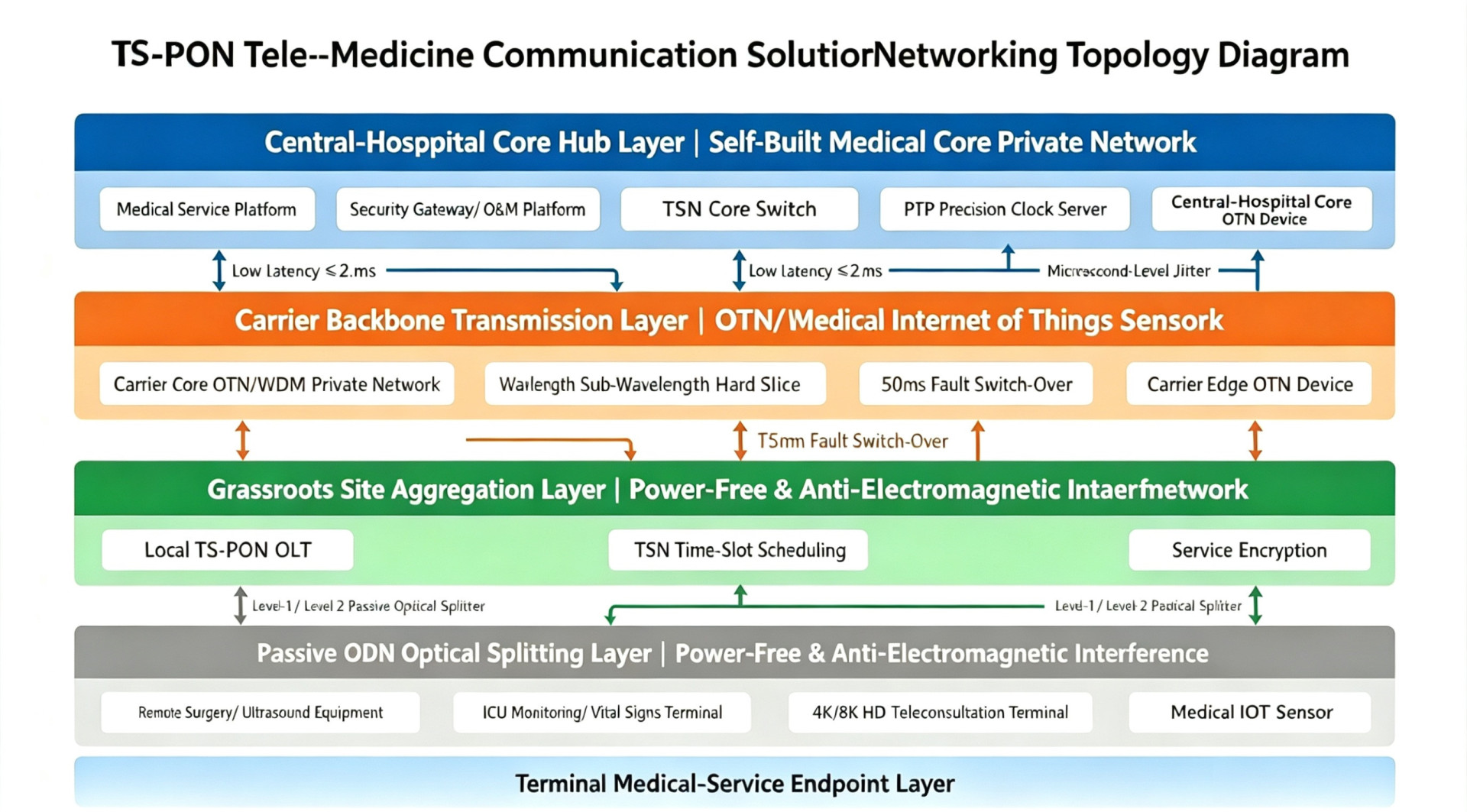
This solution implements a five‑tier hierarchical networking architecture:Terminal Access Layer → Passive Optical‑Splitting Layer → Local Aggregation Layer → Carrier‑Operated Backbone Transmission Layer → Central‑Hospital Core LayerThe topology diagram is shown below:

4. Hierarchical Service Carrying & Communication Mechanism
4.1 Principles for Hierarchical Service Matching
Based on the technical features of TS‑PON and OTN/WDM, differentiated hierarchical carrying is deployed for multiple telemedicine services, balancing real‑time performance, reliability and bandwidth requirements:
Ultra‑High‑Priority Real‑Time Control Services (Dedicated TS‑PON Carrying) Control commands for remote surgical robots, remote ultrasound / endoscopic control signals and closed‑loop equipment‑regulation instructions. Scheduled via top‑priority hard time‑slot slicing on TS‑PON for zero‑jitter, low‑latency edge transmission, with dedicated hard‑slice channels provisioned over the OTN backbone to ensure stable bidirectional closed‑loop interaction.
High‑Definition Media Services (TS‑PON Access + OTN High‑Bandwidth Backhaul) 4K/8K intra‑operative video images, multi‑party MDT tele‑consultation streams and live surgical teaching feeds. Exclusive bandwidth channels are reserved at the TS‑PON access side, and the high‑bandwidth capacity of the OTN/WDM backbone supports concurrent cross‑domain transmission of multiple ultra‑HD video streams without stuttering or image distortion.
Time‑Sequence‑Sensitive Sensing Services (Precision‑Synchronized TS‑PON Carrying) Vital‑sign data (ECG, blood oxygen, blood pressure, etc.) and monitoring data collected from IoT devices. Leveraging nanosecond‑level clock‑synchronization capabilities of TS‑PON to guarantee unified data time‑stamps, data is stably back‑hauled via OTN channels for traceable and auditable medical records.
General Office Services (Best‑Effort Carrying) Medical‑record queries, official‑document transmission and routine internet access. These services share residual bandwidth resources without consuming dedicated channels reserved for core diagnosis‑and‑treatment services, achieving clear hierarchical isolation and priority classification.
4.2 Cross‑Domain Communication Forwarding & Synchronization Mechanism
Deterministic Edge‑Side Scheduling: At the TS‑PON access layer, TSN gated scheduling marks priority levels and binds dedicated time‑slots for all medical services, eliminating bandwidth contention and delivering deterministic transmission at the terminal side.
Physically‑Isolated Backbone Transmission: Carrier‑operated OTN/WDM networks allocate independent sub‑wavelength / wavelength channels for the medical private network. These are physically separated from government, public and common enterprise services to avoid cross‑service interference, while supporting loss‑less elastic bandwidth expansion.
Network‑Wide Linked Clock Synchronization: A core PTP clock server deployed in the central hospital distributes precise timing signals to regional edge devices via the OTN backbone, which are further cascaded down to TS‑PON OLTs, ONUs and medical terminals at each site. Uniform time‑sequencing across the entire network satisfies requirements for medical‑data traceability and quality‑control compliance.
End‑to‑End Redundancy Protection: Edge‑side TS‑PON supports link fault tolerance, while the OTN/WDM backbone implements ring‑network protection and routing redundancy. Fast failure switch‑over completes within 50 ms with zero service interruption, perfectly fitting non‑stop diagnosis scenarios such as emergency rescue and remote surgery.
4.3 Advantages of the Hierarchical Networking Communication Solution
Complementary Capabilities for Full‑Scenario Adaptation: TS‑PON addresses edge‑side pain‑points regarding real‑time performance, determinism and multi‑service isolation, while OTN/WDM solves long‑haul transmission challenges for large bandwidth, high reliability and cross‑domain connectivity. Their combination covers the full spectrum of telemedicine use‑cases and compensates for the functional limitations of single‑technology networks.
Cost‑Efficient & Rapid Deployment: Re‑uses mature carrier‑operated backbone transmission infrastructure. Medical institutions are relieved from constructing long‑distance fiber backbones and deploying large‑scale active backbone hardware, significantly lowering capital‑construction, power‑supply and operation‑and‑maintenance costs while shortening project delivery cycles.
Dual‑Layer Isolation for Security & Compliance: Time‑slot‑based logical hard isolation at the TS‑PON access layer plus wavelength‑level physical hard isolation on the OTN backbone provide dual protection against data interference, leakage and tampering, fully meeting Medical Cybersecurity Class‑2 (Equal‑Protection 2.0) and telemedicine regulatory compliance standards.
Smooth Scalability & Strong Expandability: Access‑side TS‑PON PON ports and terminals can be expanded on demand, while backbone OTN/WDM networks allow flexible wavelength addition / removal and bandwidth granularity adjustment, accommodating iterative upgrades for future services including 8K diagnosis‑and‑treatment, AI‑assisted healthcare and region‑wide IoT.
High Stability & Fault‑Tolerance: Maintenance‑free, anti‑interference passive ODN terminals, paired with ring‑network redundancy and rapid failure‑switch‑over functions on the OTN backbone, drastically reduce network‑wide failure rates and guarantee long‑term stable operation of medical services.
4.4 Typical Service Communication Workflow (Pre‑Hospital Emergency Rescue / Remote Surgery)
Remote‑Surgery Workflow: Control instructions from the grassroots surgical robot → High‑priority time‑slot channel on TS‑PON ONU → Local OLT aggregation → Dedicated hard slice on carrier‑operated OTN → Central‑hospital core equipment → Specialist‑operation terminal. Synchronous 8K surgical video streams are transmitted in the reverse direction, achieving bidirectional low‑latency interaction with zero lag or stuttering.
Pre‑Hospital Emergency Workflow: Vital‑sign data and 4K monitoring video collected at the first‑aid site → Deterministic TS‑PON access → Long‑haul back‑haul over OTN/WDM backbone → ICU diagnosis‑and‑treatment platform at the central hospital. Combined with unified network‑wide clock signals, emergency data achieves real‑time synchronization to support precise clinical judgment.
5. Technical Specifications for Core Equipment
5.1 TS‑PON OLT Core Device
Port Specification: 10G‑EPON / XG‑PON‑compliant, supporting bidirectional 10 Gbps high‑speed transmission
Latency Indicator: Network‑wide end‑to‑end latency ≤ 2 ms; jitter ≤ 10 μs
Clock Synchronization: IEEE 1588v2 PTP and 1 PPS precision clock synchronization supported
Scheduling Function: TSN gated scheduling, hard time‑slot isolation and user‑defined service priority
Reliability: Link redundancy, link‑break protection and equipment hot‑standby supported
Security Features: Terminal access authentication, data encryption, traffic audit and attack‑protection capabilities
Operation & Maintenance: Network‑wide visualized management, automatic fault alarms and remote O&M
5.2 TS‑PON TSN ONU Access Device
Access Bandwidth: Bidirectional 10 Gbps, multi‑service hierarchical carrying
Service Interfaces: Gigabit Ethernet ports, RS485 / RS232 serial ports, compatible with medical equipment and IoT sensor terminals
Deterministic‑Transmission Functions: Local TSN traffic scheduling, priority marking and time‑slot binding
Synchronization Performance: PTP clock‑synchronization support to meet unified network‑wide timing requirements
Environmental Adaptability: Wide‑temperature operation and anti‑electromagnetic‑interference performance, suitable for complex machine‑room and operating‑room environments in hospitals
6. Deployment & Implementation Plan
6.1 Implementation Workflow
On‑Site Survey & Solution Refinement: Survey optical‑fiber resources, terminal‑service requirements and link distances for each hospital campus and grassroots medical node, and customize tailored networking and time‑slot‑scheduling schemes.
Core‑Equipment Deployment: Install TS‑PON OLT, clock‑synchronization server, security gateway and O&M platform in the central‑hospital machine room, and complete equipment commissioning, clock‑synchronization configuration and service‑template planning.
Passive Optical‑Network Construction: Deploy backbone optical fibers and optical splitters to build the passive ODN bearer network, which requires no intermediate power supply and simplifies cabling structures.
Access‑Equipment Roll‑out: Mount TS‑PON ONU devices at each grassroots medical site, connect them to medical‑service terminals and complete service‑adaptation debugging.
Service Debugging & Optimization: Assign time‑slot channels according to medical‑service priority levels, tune latency, jitter and bandwidth parameters, and optimize traffic‑scheduling strategies to deliver optimal performance for core medical services.
Network‑Wide Testing & Acceptance: Carry out comprehensive tests covering latency, jitter, packet‑loss rate, synchronization precision, multi‑service concurrency and security protection, then complete project acceptance and hand‑over.
O&M Training & Project Delivery: Provide training on equipment maintenance, platform operation and fault troubleshooting for hospital‑site engineering staff, and deliver the full set of technical documentation.
6.2 Deployment Advantages
Short Construction Cycle: Simplified passive‑architecture cabling removes requirements for machine‑room power‑supply renovation, greatly shortening deployment lead‑time.
Low Operation‑and‑Maintenance Costs: Passive hardware requires zero power consumption and no routine maintenance. The reduced quantity of active devices cuts total network failure points.
High Compatibility: Works with existing medical terminals, tele‑consultation systems and patient‑monitoring equipment, avoiding large‑scale legacy‑hardware replacement.
Smooth Expandability: Supports bandwidth upgrades and new‑site expansions, ready for future access of additional medical‑service terminals.
7. Network‑Security & Compliance Scheme
7.1 Closed‑Loop Protection for Dedicated Private Network
All data is transmitted exclusively over dedicated optical‑fiber private networks which are physically isolated from the internet and office external networks, eliminating risks of public‑network‑originated cyber‑attacks and medical‑data leakage, and safeguarding transmission security at the infrastructure level.
7.2 Multi‑Layer Security‑Protection Mechanism
Terminal Access Control: Real‑name authentication and whitelist‑based access are enforced for all connected ONUs and medical terminals to block unauthorized device access.
Data Encryption: Encrypted transmission protocols are deployed for service traffic. Patient‑privacy and diagnostic‑image data are encrypted end‑to‑end during transmission to prevent data tampering and theft.
Traffic Auditing: Real‑time monitoring and persistent log‑recording of network‑wide traffic. Abnormal‑flow alerts and traceable audit functions are provided to satisfy medical‑industry compliance requirements.
Attack‑Resistance Mechanisms: Built‑in anti‑DoS protection, port‑security control and traffic‑filtering functions defend against anomalous network attacks.
7.3 Industry‑Regulation Compliance
This solution fully complies with requirements specified in Specification for Cybersecurity of Medical Institutions, Administrative Rules for Telemedicine Services and Classified Protection 2.0 (Cybersecurity). Built‑in capabilities for data traceability, operation auditing and fault‑log retention enable smooth compliance audits within the healthcare sector.
8. Operation‑and‑Maintenance Support System
8.1 Visualized Intelligent‑O&M Platform
A network‑wide operation‑and‑management platform delivers visualized monitoring for equipment health, link quality, service traffic, latency‑jitter metrics and online‑terminal status. Automatic anomaly identification and pop‑up fault‑warning notifications drastically accelerate fault‑location workflows.
8.2 Fault‑Redundancy Guarantee
Core equipment and backbone links support redundant backup. Automatic switch‑over is triggered during sudden failures to ensure zero interruption of critical telemedicine services. The passive ODN architecture eliminates active‑component failure points and improves overall network stability.
8.3 After‑Sales O&M Services
7×24‑hour technical support is provided with a rapid‑response fault‑handling mechanism: general‑fault response within 2 hours, on‑site troubleshooting for major failures within 4 hours. Periodic network inspections, parameter optimization and hardware maintenance are arranged to sustain long‑term stable network operation.
9. Solution Value & Benefit Analysis
9.1 Service‑Oriented Value
Breaks through traditional telemedicine network bottlenecks and enables routine deployment of high‑end services including remote surgery, real‑time emergency rescue and high‑definition tele‑consultation, improving overall diagnosis‑and‑treatment capacity. Facilitates the downward flow of premium medical resources, narrows urban‑rural and cross‑regional healthcare gaps, and supports national tiered‑diagnosis‑and‑treatment policy implementation. Unified network‑wide time‑sequencing and traceable data standardize telemedicine workflows and raise the level of medical‑quality control and compliance management.
9.2 Operation‑and‑Maintenance‑Oriented Value
The passive optical‑network architecture reduces equipment‑power consumption, failure probability and human‑resource overhead for network maintenance, lowering hospital‑side operational expenses. The streamlined architecture paired with intelligent‑O&M functions reduces network‑administration complexity and enhances network stability and reliability.
9.3 Long‑Term Developmental Value
Builds a smoothly‑expandable deterministic optical‑network foundation for region‑wide healthcare services, ready for iterative upgrades of emerging services such as AI‑powered remote diagnosis‑and‑treatment, 5G‑enabled remote surgery and big‑data‑driven smart healthcare. It delivers core network‑level support for hospitals’ digital‑transformation and smart‑hospital initiatives.
10. Risk‑Assessment & Mitigation Measures
Risk of Terminal‑Equipment Compatibility: Some legacy medical terminals lack native TSN‑scheduling compatibility. Mitigation Strategy: Provide dedicated terminal‑adaptation conversion solutions to support legacy hardware without full‑system replacement.
Risk of Delayed Deployment Progress: Construction activities in medical facilities must avoid peak diagnosis‑and‑treatment hours. Mitigation Strategy: Implement off‑peak, zone‑by‑zone phased deployment to ensure hospital clinical services remain undisrupted.
Risk of O&M‑Team Adaptation: Hospital‑site maintenance staff lack operational familiarity with the new‑generation technology. Mitigation Strategy: Deliver specialized technical training, full‑set O&M manuals and long‑term remote technical‑support services.
Risk of Cost Overrun: TS‑PON hardware costs are higher than conventional PON‑based solutions. Mitigation Strategy: Deploy equipment in phased expansion cycles. Prioritize resources for core diagnosis‑and‑treatment services and complete full‑network upgrade in gradual stages.
11. Summary & Future Outlook
The TS‑PON telemedicine solution innovatively integrates time‑sensitive deterministic networking technology with passive optical‑network architecture. It targets core pain‑points of legacy telemedicine networks, such as uncontrollable latency, service‑bandwidth contention, insufficient reliability and weak cybersecurity, delivering dedicated, low‑latency, near‑zero‑jitter, highly‑reliable, secure and traceable network‑transport capacity for key services including remote surgery, real‑time emergency rescue, high‑definition tele‑consultation and region‑wide patient monitoring. With a streamlined architecture, efficient maintenance workflows and robust regulatory compliance, the solution is widely applicable for constructing multi‑level medical consortia, smart hospitals and pre‑hospital emergency‑rescue systems.
Looking ahead, iterative upgrades to 50G‑TS‑PON technology will further expand the solution’s capacity to support emerging‑use‑cases such as ultra‑high‑definition medical treatment, AI‑intelligent diagnosis‑and‑treatment and region‑wide collaborative control of unmanned medical devices. Combined with 5G‑TSN wireless deterministic‑networking technology, a "wired + wireless" dual‑redundancy region‑wide deterministic smart‑healthcare network will be constructed, fully empowering healthcare digital‑transformation and the inclusive sharing of premium medical resources.